Agroforestry workshop at Spitak State College
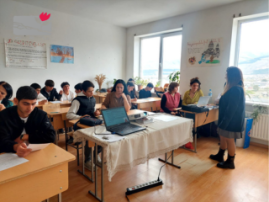
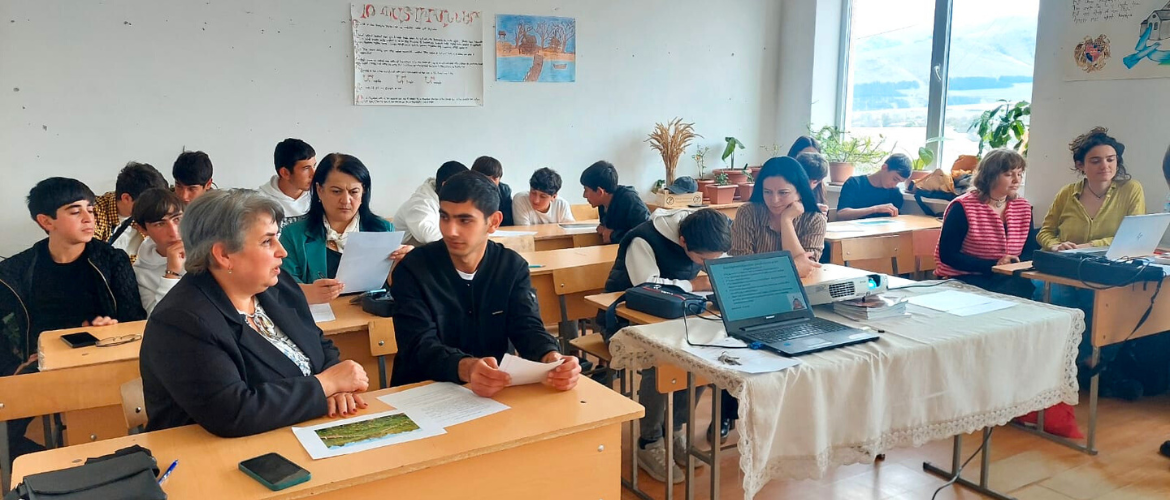
On October 20, “Shen” NGO held the first workshop on agroforestry for students of the Spitak State College in Lori Marz. This workshop was an important step as part of the capacity building and provision of educational resources component of “The establishment and strengthening of agricultural cooperatives with the use of improved legislation and modern technologies” project, implemented by the “Shen” NGO with funding from the German organization Bread for the World.
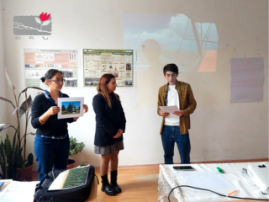
During the two-hour workshop, students and lecturers were introduced to agroforestry systems through a participatory activity that involved discussing a picture in small groups, which depicted a specific agroecosystem (such as monocultures, grassland, silvopasture, alley cropping, etc.).
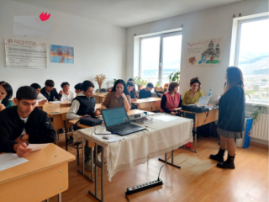
The second activity involved presenting each group’s findings on the inputs/outputs that the agroecosystem requires/provides, as well as the ecological interactions/ecosystem services they identified, along with the biodiversity richness of the system. The final part of the workshop consisted of summarizing the main characteristics of agroforestry systems. To ensure the participants had a clear understanding, we concluded the activity by showing pictures of other agroecosystems, and they had to identify whether each was an agroforestry system.

This participatory approach was highly beneficial, as it enabled students to actively learn about agroforestry, building on their existing agricultural knowledge. Second, exchanging ideas and contrasting the knowledge with the knowledge gaps is a good way to develop critical thinking and adopt new concepts. Lastly, the students had a good opportunity to practice their public speaking skills, since it is not something they do very often, according to the lecturers. The result was a “word cloud” that students and lecturers created by answering the question: “How do you define agroforestry in one word?”
Students’ and lecturers’ interest in agroforestry brings great expectations for further cooperation with Spitak State College. The future of agroforestry in Armenia can be guaranteed if educational institutions are involved in the process of forming and training future agroforestry experts and extensionists.