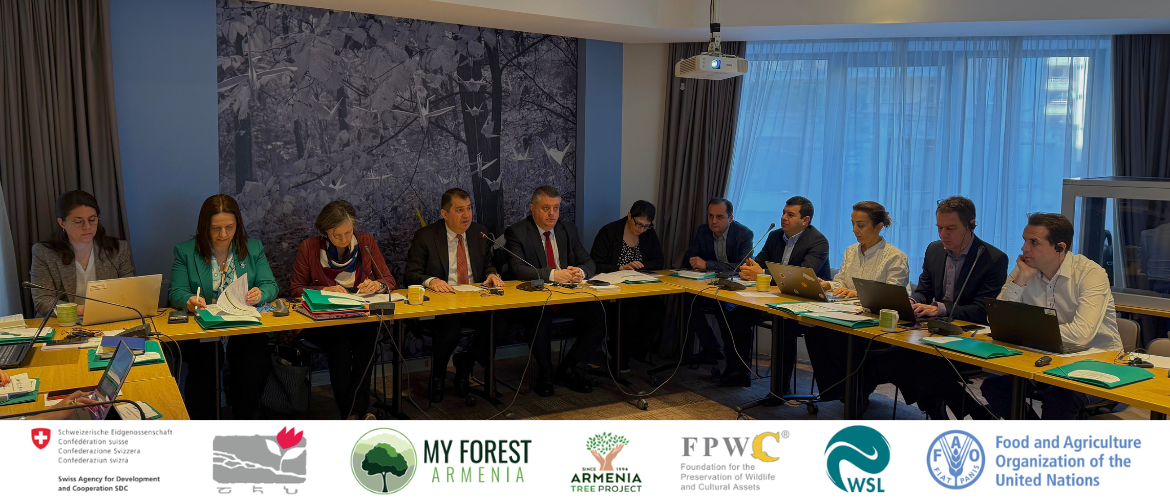
2nd Meeting of FORACCA Steering Committee
One year after launch, the Forest Restoration and Climate Change in Armenia (FORACCA) project is showing clear progress in both communities and institutions across Armenia.
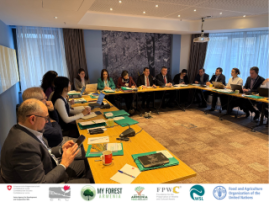
At the Second Steering Committee meeting in Yerevan, representatives from the Government of Armenia, the Swiss Agency for Development and Cooperation (SDC), WSL, FAO, ArmHydromet, and members of the Forest Alliance of Armenia, including Shen NGO, Armenia Tree Project (ATP), My Forest Armenia (MFA), and the Foundation for the Preservation of Wildlife and Cultural Assets (FPWC), met to review results and agree on priorities for the coming year.
From Community Action to National Systems
Over the past year, FORACCA has moved from planning to action. In participating communities, restoration and agroforestry activities are improving landscapes and creating new livelihood opportunities.
According to “Shen” NGO, the most visible results are at the community level, where engagement is increasing, and ownership is strengthening. As noted by Hayk Minassian, President of the Board of “Shen” NGO, “There is a clear need for functioning coordination mechanisms, as effective implementation depends not only on strong community engagement but also on institutional cooperation and continuity.”
At the same time, progress at the national level supports these efforts. Improved climate modeling and forest monitoring systems are helping provide more accurate, data-based decisions in forest and climate governance.
Strong Partnerships Driving Results
Partnership remains a key strength of the FORACCA project, linking local experience with international expertise and national policy processes.

Opening the meeting, Deputy Minister of Environment Ara Mkrtchyan emphasized the broader significance of the initiative: “FORACCA represents a systemic response, combining international expertise with local capacity strengthening, and is closely aligned with Armenia’s climate commitments.”
From the donor perspective, the project has built a solid foundation for scaling. As highlighted by Ursula Läubli, Deputy Head of Mission and Deputy Regional Director of Swiss Cooperation South Caucasus, “The project has successfully transitioned to its operational phase, with partnerships established and the first tangible results already visible.”
The Forest Alliance of Armenia continues to play an important coordinating role by bringing member organizations together to share experience, align approaches, and address common challenges.
Addressing Barriers Through Dialogue
The meeting also provided space to discuss ongoing challenges in the sector.

Issues related to land use, Environmental Impact Assessment procedures, and taxation continue to present barriers to implementation. These concerns, raised by multiple partners, highlight the need for coordinated solutions across institutions.
Deputy Minister Ara Mkrtchyan acknowledged these challenges, noting that while broader reforms may be required, practical solutions must also be developed to address urgent issues.
For the implementing partners, such dialogue remains essential to ensuring that community-level efforts can be effectively supported and scaled.
Looking Ahead: Expanding Impact and Strengthening Systems
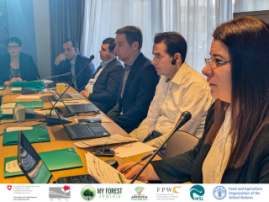
The Steering Committee approved the updated project logframe and the Year 2 workplan․In the coming year, efforts will focus on expanding restoration activities, strengthening the use of climate information, and building the capacities needed to sustain impact over time.
As FORACCA enters its second year, partners are focusing on expanding impact while strengthening the systems that support it.
The project is also part of a broader national and international context, with upcoming opportunities such as COP17 providing a platform to highlight Armenia’s progress and deepen collaboration.
Reflecting on the project’s approach, Ursula Läubli emphasized, “Combining technical expertise with local knowledge, and linking community action with national dialogue, remains central to achieving meaningful and lasting results.”
A Shared Commitment
The meeting concluded with a strong sense of shared responsibility among all partners.
FORACCA continues to show that forest restoration is not only about planting trees, but also about building resilient systems, strengthening cooperation, and empowering communities. “Shen” NGO remains committed to this vision, working alongside partners to ensure that restoration efforts lead to lasting environmental and social benefits across Armenia.
“The Forest Restoration and Climate Change in Armenia” (FORACCA) project is funded by the Swiss Agency for Development and Cooperation (SDC) and co-funded by the four implementing organizations under the Forest Alliance of Armenia, including Shen NGO, Armenia Tree Project NGO (ATP), My Forest Armenia NGO (MFA), and Foundation for the Preservation of Wildlife and Cultural Assets (FPWC). The project is implemented in collaboration with the Swiss Federal Institute for Forest, Snow, and Landscape Research (WSL) and the UN Food and Agriculture Organization (FAO).